
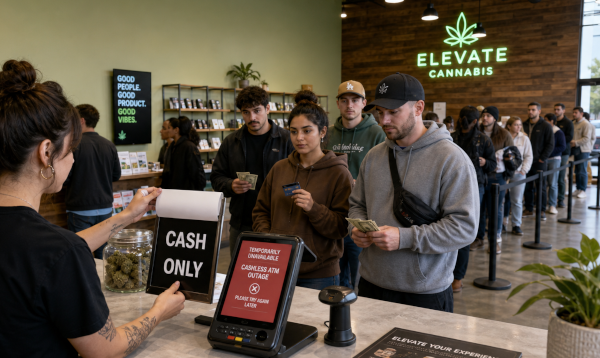
If you run a cannabis dispensary today, you already know that payments can feel like walking a tightrope. Federal illegality, card‑brand rules, and shifting bank risk policies all collide right at your checkout counter. Recent nationwide and multi‑state disruptions to cashless ATM and PIN‑debit style programs have made that tightrope even thinner, with thousands of dispensaries suddenly forced back to cash‑only almost overnight.
This article breaks down what actually happened in these outages, why cashless ATMs are so fragile, and how you can protect your dispensary from the next disruption.
What is a “Cashless ATM” in a Dispensary?
A cashless ATM is not a true card‑present POS transaction. Instead, it mimics an ATM withdrawal at the point of sale: the system runs a debit card transaction (often in set increments, like 50 or 60 dollars), prints a receipt, and the budtender gives the customer change in cash.
These workarounds exploded in popularity because major card brands and many banks do not want to be directly involved in cannabis transactions while the product remains illegal at the federal level. For dispensaries, cashless ATMs seemed like a way to meet customer demand for card payments without waiting for federal reform.
Why These Programs Are So Fragile
Under the hood, cashless ATM and similar PIN‑debit programs are highly dependent on a few key players: sponsor banks, ATM networks, and specialized processors willing to underwrite cannabis risk. When any one of these partners changes course, entire portfolios of dispensaries can lose card acceptance instantly.
Because many of these programs live in a regulatory gray area, they are exposed to card‑brand enforcement, bank risk reviews, and legal actions that can trigger immediate shutdowns rather than slow, negotiated phase‑outs.
The 2022 Crackdown: A Warning Shot
In late 2022, the industry got a preview of what systemic disruption looks like. Major ATM processors disabled some cannabis‑focused processors’ ability to route cashless ATM transactions through their networks.
The fallout was fast and widespread. Dispensaries in multiple states reported outages, with staff urging customers to bring cash and posting “cash only” signs on the doors. Some reporting suggested that, by the end of that weekend, only about 20 percent of cannabis retailers could still use cashless‑ATM‑style payments.
Rolling Shutdowns: Processors Pulling the Plug
The story did not end in 2022. Over the following years, multiple cannabis payment providers were reported to have shut down many of their cashless ATM networks.
For dispensaries, that meant repeated waves of outages: one day the “debit” button works, the next day it doesn’t, often with minimal warning and little recourse except to scramble for cash or rush to implement a new provider. The pattern has been episodic but consistent—whenever a sponsor bank, network, or processor decides the risk is too high, merchants pay the price.
March 2026: A Nationwide Disruption
March 2026 marked one of the most significant disruptions so far. Industry sources describe a nationwide event that hit cashless ATM and PIN‑debit style programs across multiple platforms and states.
Early counts suggested at least 1,000 dispensaries were impacted, with some estimates putting the number closer to 3,000, all losing the ability to process these “debit‑like” transactions in a very short window. Overnight, stores that had been heavily reliant on cashless ATM rails had to move to true cash‑only, leading to long lines, frustrated customers, and real revenue hits.
What Actually Caused the 2026 Outage?
While it might look like a simple “system outage” from the dispensary floor, the 2026 disruption was primarily compliance‑driven. Analyses point to sponsor banks and upstream financial partners withdrawing support from certain cannabis processors, which effectively flipped the “off” switch on transaction authorization for large books of merchants.
Key drivers included:
- Stricter bank risk reviews on cannabis portfolios
- Terminal IDs and transaction coding that did not align with evolving card‑brand expectations
- Over‑reliance on a single sponsor bank or network to support a large number of dispensaries
When those banks changed their risk posture, there was no graceful degradation—authorization simply stopped.
Regulatory and Legal Pressure Is Mounting
Behind the scenes, regulators and plaintiffs’ attorneys have been paying increasing attention to cashless ATM schemes. Lawsuits and commentary have argued that these solutions misrepresent cannabis purchases as standard ATM withdrawals, creating potential violations of card‑brand rules and consumer protection laws.
In markets like Massachusetts, there is an additional requirement that all ATMs—including cashless ATMs—be registered with the Commissioner of Banks, adding yet another compliance checkpoint for dispensaries. As scrutiny rises, sponsor banks and processors have every incentive to cut ties quickly if they perceive elevated risk.
How Outages Impact Day‑to‑Day Operations
When these systems go dark, the impact is immediate and tangible:
- Longer lines and slower checkouts as staff handle more cash and explain the situation to each customer
- Increased security and shrink risk from moving larger volumes of physical cash on‑site and in transit
- Lost sales from customers who arrive expecting to pay with a card and are unwilling or unable to come back with cash
Multi‑state operators that leaned heavily on cashless ATM programs have felt this acutely, but smaller independent shops are often hit harder because they lack backup providers and diversified banking relationships.
Risk‑Mitigation Strategies for Dispensaries
The big question is: what can you do about it? While no one can completely eliminate risk in cannabis payments, there are practical steps to materially reduce exposure:
- Avoid single‑point‑of‑failure payment stacksDo not put your entire business on one sponsor bank or one gray‑area cashless ATM provider. Build redundancy into your payment stack wherever possible.
- Prioritize compliant railsFavor true debit, ACH, or closed‑loop solutions that are structured to align with card‑brand rules and banking regulations, rather than relying solely on workarounds.
- Maintain a backup acceptance pathWork with your POS and payments partners to ensure you can quickly toggle to:
- Non‑integrated debit or a separate terminal
- Alternative rails (for example, a compliant PIN‑debit or ACH solution) if your primary provider goes down
- Tighten documentation and registrationIn states like Massachusetts, verify that any ATM or cashless ATM at your location is properly registered and documented. This can help reduce regulatory‑driven surprise shutdowns.
- Build a communication playbookHave template signage, SMS/email copy, and staff talking points ready for “payments down, cash only” scenarios, so you can manage customer expectations in real time.
What This Means for the Future of Cannabis Payments
Looking forward, the trend line is clear: as card brands, banks, and regulators continue to tighten controls, cashless ATM programs will remain a high‑risk bet rather than a stable foundation for your payments strategy.
Industry experts expect a gradual shift toward more transparent, compliant debit and ACH‑based solutions, and toward banking relationships that can survive deeper scrutiny. Dispensaries that get ahead of that curve—by diversifying rails, prioritizing compliance, and planning for outages—will be far better positioned than those who cling to gray‑area workarounds until the next switch gets flipped.
Final Thoughts
Cashless ATMs helped cannabis retailers bridge a crucial gap at a time when the traditional payments ecosystem would not touch the industry. But as recent outages have shown, that bridge is cracking.
If your dispensary still leans heavily on cashless ATM rails, now is the time to audit your risk, re‑evaluate your payment mix, and start building a more resilient, compliant setup before the next “nationwide disruption” headline hits.
Sources and Credits
This article is based on industry reporting and analysis of:
- Nationwide and multi‑state disruptions to cashless ATM and PIN‑debit style programs impacting cannabis dispensaries in 2022–2026.
- Public commentary on regulatory and legal scrutiny of cashless ATM models, including enforcement risks and ATM registration requirements in states such as Massachusetts.